Joseph of Arimathea
Le Morte d'ArthurJoseph of Arimathea is the foundational figure in the book’s account of the Holy Grail: he carries the vessel associated with the Last Supper and Christ’s blood into Britain, where it becomes the source of a sacred history extending from King Evelake to Galahad. Though Joseph appears chiefly through testimony, relics, and visions, his actions give the Grail quest its Christian lineage and connect its material objects to faith, healing, and spiritual worth.
Identity and the Grail tradition
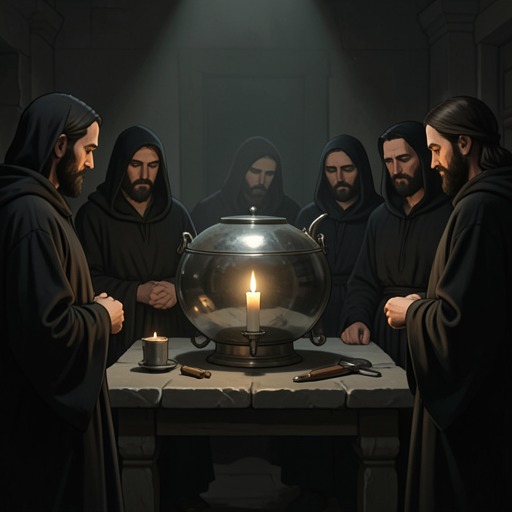
The introductory account identifies the Grail with the dish that held the paschal lamb at the Last Supper. Joseph takes it from the house where the supper was held and receives in it the blood from Jesus’s wounds. He then brings the vessel, with part of that blood, to Britain and converts many people. In the book’s account, the Grail is therefore at once a vessel with a sacred history and a sign of the Christian faith established in Britain.
The introduction also places this tradition among several explanations of what the Grail was: the dish of the Last Supper, the vessel that received the Saviour’s blood, or the sacramental cup itself. For Malory’s narrative, it adopts the first identification, then follows the vessel’s later connection with the blood. The account further relates that a tower was built at Corbenic to keep it. The Grail thus enters the story not as an unexplained marvel alone, but as an object given a history, a custodian, and a place in the Christian past.
Joseph’s journey and King Evelake
The narrative recounts Joseph’s arrival in the eastern city of Sarras with a company of his kindred. There he encounters King Evelake, who is at war with the Saracens and especially with his powerful cousin, King Tolleme. Joseph’s son tells Evelake that he will be defeated and killed unless he abandons the old belief and accepts the new faith. Evelake agrees to believe in the Holy Trinity, and a shield is made for him in the name of the one who died on the cross.
In battle, the shield’s cross is concealed by a cloth until Evelake is in great danger. When the cloth is removed, his enemies see the figure of a man on the cross and are defeated. The episode gives the shield a particular function: it protects through a sign of Christian faith, not through its material strength alone. When one of Evelake’s men loses a hand, Joseph directs him to touch the cross; the hand is restored. Evelake and most of the city’s people are then baptised.
Joseph later leaves Sarras, and Evelake insists on accompanying him. They reach Britain, where a pagan captor imprisons Joseph. News of this brings Mondrames and his people to intervene, drawn by Joseph’s renown. These events make Evelake’s conversion and the shield part of a longer migration: Joseph’s mission carries the faith and its relics from Sarras into Britain, even as his own life there is marked by imprisonment and eventual death.
The shield, Joseph’s blood, and Galahad
As Joseph lies near death, Evelake asks for a token to remember him. Joseph asks for the shield he had given Evelake. Unable to stop his bleeding, he marks a cross on it with his own blood and tells Evelake that the shield will remain fresh as a remembrance of their bond. It is not, however, a relic anyone can bear without consequence: no one may carry it until Galahad, and the final member of Joseph’s lineage will bear it and perform many marvellous deeds.
Joseph directs Evelake to leave the shield where the hermit Nacien will be buried. He foretells that the appointed knight will come there on the fifteenth day after receiving knighthood. The story later fulfils this history through Galahad, who receives the white shield and is told how it came from Joseph and Evelake. Its cross has vanished, and the account explains that it appeared in battle and disappeared afterwards. Joseph’s blood-marked sign, preserved through the shield’s history, thus becomes a test of succession and worth rather than an unrestricted emblem of power.
Memory, prophecy, and the Grail fellowship
Joseph’s influence also survives through narrative and ritual. During an adventure, Sir Bors hears an old man sing of Joseph’s coming to Britain. The episode links Joseph’s arrival to a vision involving a dragon, a leopard, a dove, and the sacred spear; the old man’s song places the British Grail tradition within the strange signs that Bors encounters. Joseph’s story is therefore not confined to the account of the vessel or the shield: it recurs as remembered history within the quest’s sequence of revelations.
Merlin’s account of the Round Table makes the connection explicit at the level of the fellowship. He says the Round Table signifies the roundness of the world, to which both Christians and heathens come, and that the truth of the Grail will be known through its fellows. The Grail’s chosen knights are described through the image of three white bulls, two maidens and a chaste knight, with one surpassing earthly knights in strength and courage. The Siege Perilous is made for the knight who will fulfil that distinction. Joseph’s tradition thus supplies more than an origin story for a holy object: it provides the Christian history through which the Round Table’s fellowship and its quest acquire their spiritual measure.
Vision and spiritual inheritance
The Grail story culminates in a vision that recalls Joseph as the first bishop of Christendom. At King Pelles’s silver table, four angels bear a bishop-like figure in a chair; the inscription identifies him as Joseph, whom the Lord aided in Sarras. Though long dead, Joseph appears within a sacred ceremony attended by angels, candles, a towel, and the bleeding spear. The vision presents his remembered history as part of a continuing sacred presence, rather than as a past episode closed by his death.
A hermit’s explanation of Sir Launcelot’s vision likewise places Joseph within a genealogy leading to Galahad. It recounts Joseph’s preaching of King Evelake’s victory, names the generations that follow, and identifies Galahad as the son of Launcelot and King Pelles’s daughter. Galahad is the promised knight who surpasses earthly knights; Launcelot is told that his son’s spiritual distinction does not erase his own responsibility for sin. Joseph’s legacy therefore joins lineage to moral distinction without treating descent alone as salvation. Through the vessel, the shield, the remembered journey, and the prophecies fulfilled in Galahad, Joseph of Arimathea anchors the Grail quest in a history of Christian conversion while making its ultimate achievement depend on the character of the knight who inherits it.